
News
Stainless Steel Ball Valve Seal Selection: A Decision-Making Guide Based on Temperature and Pressure for Inquiries
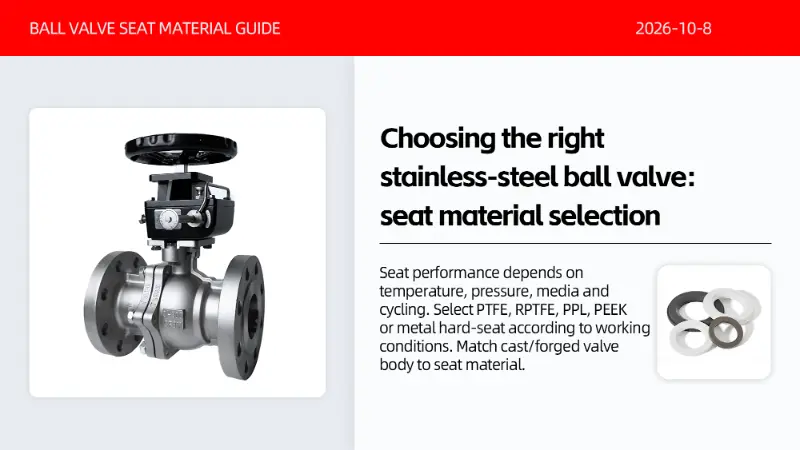
Choosing the right stainless-steel ball valve is, first and foremost, a sealing decision driven by temperature. The same body that seals perfectly with a PTFE seat at 100 degrees Celsius can weep, seize or fail once the softening, cold-flow and pressure limits of that seat are exceeded. Pressure, media and cycling then narrow the choice within the seat family.
For customers, the practical problem is that nominal pressure figures stamped on a body are often assumed to hold across all temperatures. In reality a cast stainless ball valve rarely reaches its cold rating when hot, when cycled, or when handling abrasive or high-pressure gas. A defensible RFQ should describe the actual thermal and pressure duty first, then require the bidder to show how the offered seat and body construction meet it.
Quick Customer Verdict
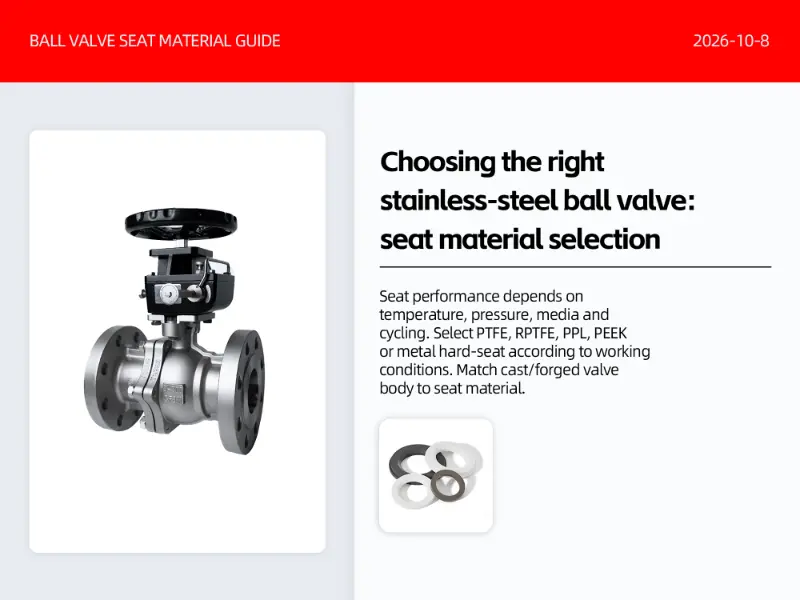
Use PTFE for clean, general water/oil/gas service up to roughly 150°C. Move to RPTFE above that: the white general-purpose fill for mid-temperature, the black wear-and-pressure grade for higher pressure, higher temperature or abrasive duty. Step up to PPL, PEK or TFM1600 for the 200–260°C band, and switch to a metal hard-seat from about 260°C upwards, or whenever abrasion, fire-safe basis or extreme cycling is the requirement. Pair every soft seat with a forged rather than cast body as pressure rises.
01Start with the thermal duty, not the seat name
State the fluid, phase, solids content, corrosiveness, design and operating pressure, and the minimum and maximum temperature the valve will actually see — including start-up spikes, shutdown, thermal cycling and heat-tracing. Identify whether the valve is for isolation, control, emergency shutdown or a combination of duties.
A seat chosen for the nominal line temperature but ignored during a steam-out, a flash event or a cold start is the most common field failure. Record the worst-case temperature-time combination, not the steady-state average.
02Understand the soft seats: PTFE and RPTFE
PTFE (virgin polytetrafluoroethylene) is the baseline soft seat: excellent chemical resistance, very low torque, low cost and a wide chemical window, but it cold-flows, wears under abrasion and is temperature-limited. It suits clean, low to medium pressure, non-abrasive service up to about 150°C.
RPTFE (filled, reinforced PTFE) trades a little chemical inertness for much better anti-extrusion, anti-cold-flow and wear behaviour. There are two grades customers should name explicitly:
White RPTFE
General-purpose reinforced compound (glass-fibre or mineral filled). Extends the safe band to roughly 200°C and handles medium pressure well. Choose it when the duty leaves the PTFE envelope but is not severely abrasive or high pressure.
Black RPTFE
Wear-and-pressure grade (carbon-graphite or molybdenum-disulphide filled). Self-lubricating, abrasion-resistant, stabilised to roughly 220–230°C. Specify the black grade for high-pressure, high-cycle or abrasive duty — and say "black, carbon-graphite filled" in the enquiry so it is not supplied as the white general grade.
03Step up to high-performance polymers: PPL, PEK and TFM1600
Above the RPTFE band, three engineered polymers cover the high-temperature soft-seat window, roughly 200 to 260°C.
PPL is a filled, high-temperature polymer seat with good strength and creep resistance at elevated temperature, suited to hot oil, steam-adjacent and medium-high pressure service where PTFE-derived seats would extrude.
PEK (polyetherketone / PEEK-class) is a rigid engineering polymer with excellent wear and load capacity, chemical resistance and a continuous rating near 250–260°C. It is the preferred seat for high-pressure, high-temperature, high-cycle isolation and for abrasive media that would destroy PTFE.
TFM1600 is a modified, higher-density PTFE with much lower cold flow, lower extractables and better thermal stability than virgin PTFE. It spans cryogenic to about 260°C and is chosen for ultra-clean, high-purity, low-emission or vacuum service where a normal PTFE seat would not hold its form.
04When soft seats end: the metal hard-seat
From roughly 260°C upwards, or wherever the media is abrasive, solid-bearing, coking or spark-risk, a soft polymer seat is no longer the right answer. The metal hard-seat (ball and seat both coated or overlayed, e.g. Stellite / tungsten carbide) tolerates high temperature (typically 400–600°C and above, depending on trim), erosion and fire-safe duty.
The trade-off is honesty: a metal seat does not give bubble-tight shutoff like a soft seat. It is selected for high temperature, abrasion and fire-safe basis, and the shutoff class must be defined realistically. If both ultra-high temperature and tight shutoff are required, expect a metal-seated valve lapped to a defined leakage rate.
05Match the body to the duty: cast vs forged
This is where the nominal pressure ratings mislead. Cast stainless bodies are economical and fine for general, moderate-temperature, moderate-pressure service, but porosity and wall-thickness variability mean they rarely hold their stamped rating when hot, under surge or at high pressure. As pressure and temperature rise, require a forged (bar-stock) body — denser, stronger, with consistent wall thickness — even though the seat itself is a soft polymer.
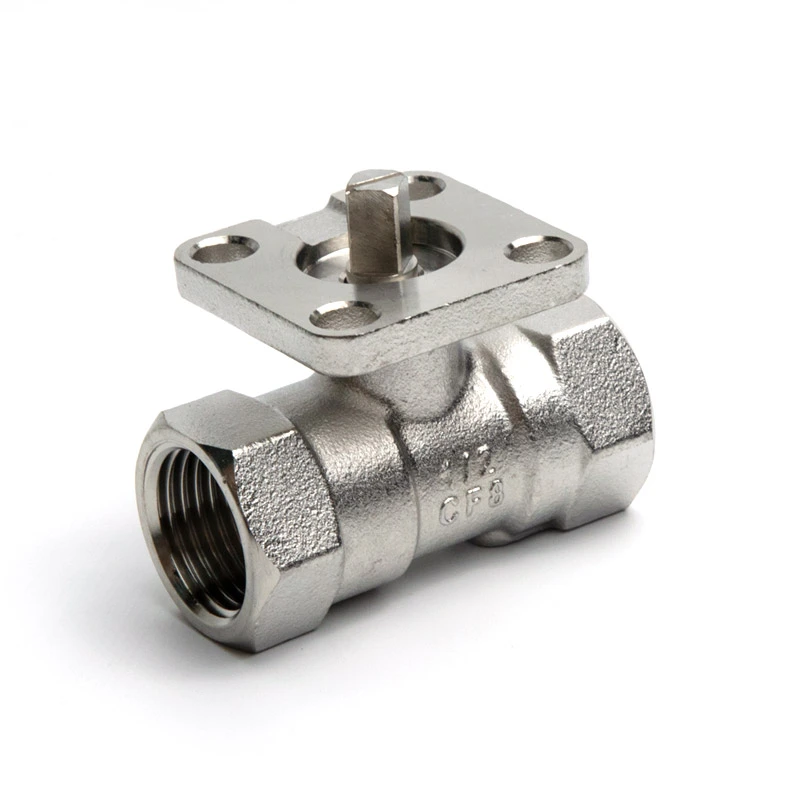
Confirm body material (CF8M/CF8 casting, or F304/F316 forging), end connection (NPT threaded, socket-weld or flanged), bore (reduced vs full) and that material certification (e.g. EN 10204 3.1) is traceable to the exact valve.
06Combine temperature and pressure into one matrix
Do not read temperature alone. At a given temperature, higher pressure pushes you one tier up in seat hardness. Use the matrix below as a starting point and require the supplier to confirm the rated pressure-temperature point for the exact seat/body combination, not a catalogue value.
| Temperature Band | Low Pressureup to PN40 / Class 150 | Medium PressurePN64 – PN100 / Class 300 | High PressurePN160+ / Class 600 & above | Body Note |
|---|---|---|---|---|
| Up to ~150°CClean · General | PTFE (virgin) | RPTFE — white | RPTFE — black | Cast 304/316 OK at low DP; move to forged as DP rises |
| ~150 – 200°CMid temperature | RPTFE — white | RPTFE — white or black | RPTFE — black | Prefer forged body at medium / high DP |
| ~200 – 260°CHigh temperature | RPTFE — black / TFM1600 | PPL or PEK (PEEK) | PEK (PEEK), reinforced | Forged body required; confirm derated pressure at peak T |
| Above ~260°CAbrasive · Fire-safe | Forged high-temp body; define real leakage class |
TFM1600 also covers cryogenic duty (down to about −200°C) where low emission and dimensionally stable sealing matter; for general cold service PTFE is normally sufficient.
07Ask for rated, de-rated data, not catalogue numbers
Request the pressure-temperature derating for the exact seat and body at the actual duty point, the shutoff test method and acceptance basis (e.g. API 598 / ISO 5208), the seat compound by colour and filler, and evidence that the forged body meets the intended pressure at maximum temperature. A low catalogue figure that excludes deposits, ageing, thermal cycling and the selected seat material is not a usable selection.
ACopy-ready RFQ clause
Copy · Paste Into Your Enquiry
Bidder shall state the maximum and minimum design temperature, the design pressure at maximum temperature, the media and any solids or abrasion, and shall propose a specific seat compound (PTFE / white RPTFE / black RPTFE / PPL / PEK / TFM1600 / metal hard-seat) together with a cast or forged 304/316 body matched to the duty. The offer shall show the pressure-temperature derating curve for the exact seat/body, the shutoff test standard and acceptance rate, end connection, bore, torque calculation, and EN 10204 3.1 material certification traceable to the offered valve. Where a nominal pressure rating is quoted, bidder shall confirm the usable pressure at maximum temperature, not the cold rating. All deviations shall be listed before award.
BPre-award checklist
01
Worst-case temperature (spikes, cycling, cold start) and design pressure are defined.
02
Seat compound is named explicitly, including white vs black RPTFE filler.
03
Pressure-temperature derating at the actual duty point is supplied, not a cold nominal.
04
Body is cast or forged as appropriate to pressure and temperature.
05
Shutoff class is realistic for soft vs metal seat.
06
Material certificates trace to the offered valve.
07
Torque and actuator sizing use the real operating envelope.
08
Installed and lifecycle cost, including spares, is compared.
Explore Shangtai's stainless-steel ball valve range, covering soft-seat (PTFE, white and black RPTFE, PPL, PEK, TFM1600) and metal hard-seat constructions in cast and forged bodies. Send the service data, actual temperature range, design pressure, media and abrasion level with the enquiry, and Shangtai will match the seat and body to the duty rather than to a nominal rating.
Related News
- Technical Insight: 2000 WOG 2-Piece High Platform Ball Valve - Design Features & Application Environments
- How Can a Three Way Ball Valve L Port Improve Flow Control in Industrial Piping Systems
- Why Are Stainless Steel Valves Preferred in Data Center Liquid Cooling Pipelines?
- Why Is a 1PC Electropolished Stainless Steel Direct Mount Ball Valve a Smart Choice for Modern Fluid Control
- Check Valve Market Advances with Major Projects and Technological Breakthroughs
- Flanged Ball Valves: Market Growth and Application Expansion
Leave me a message
New Products
News Recommendations